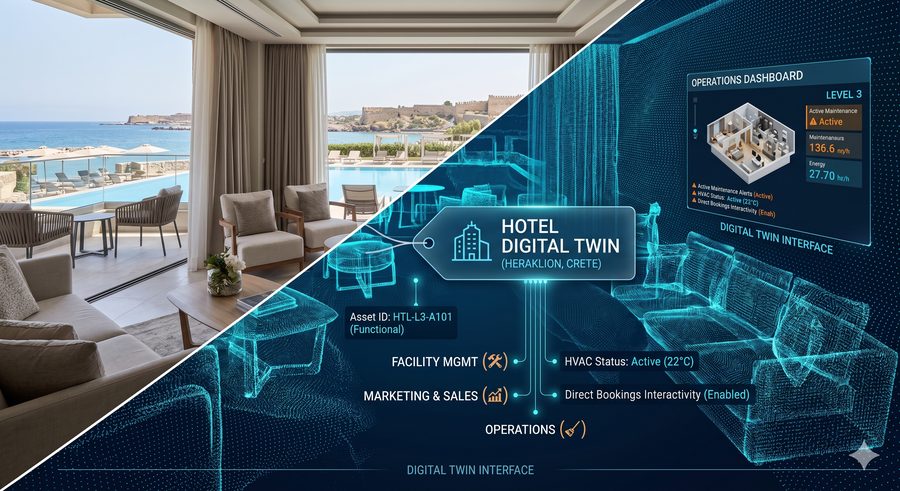
The term "digital twin" has been used so loosely in recent years that it has lost its meaning. Sometimes it refers to a photorealistic 3D rendering, sometimes to a sensor network, sometimes simply to a walkthrough video. For a hotelier weighing up whether the investment is worth it, that vagueness is the first obstacle. So let us set out what we mean by it, what we hand over, and where it translates into real benefit.
What it is — and what it isn't
A digital twin is a faithful, measurable record of the building as it stands today. In survey terms, an As-Built record: not what was meant to be built, but what is actually there.
The distinction from a 3D rendering matters. A rendering is drawn; a digital twin is measured. It is produced by LiDAR scanning, which captures millions of points with their real coordinates. The result is not a picture of the space but data about the space — which is why you can take measurements from it rather than merely look at it.
Nor is it an automation system. It does not replace your BMS and it does not read sensors in real time. It is the accurate record of the infrastructure that everyone else works on top of.
Two levels, depending on what you need
In practice a digital twin comes in two levels, and most hotels only need the first.
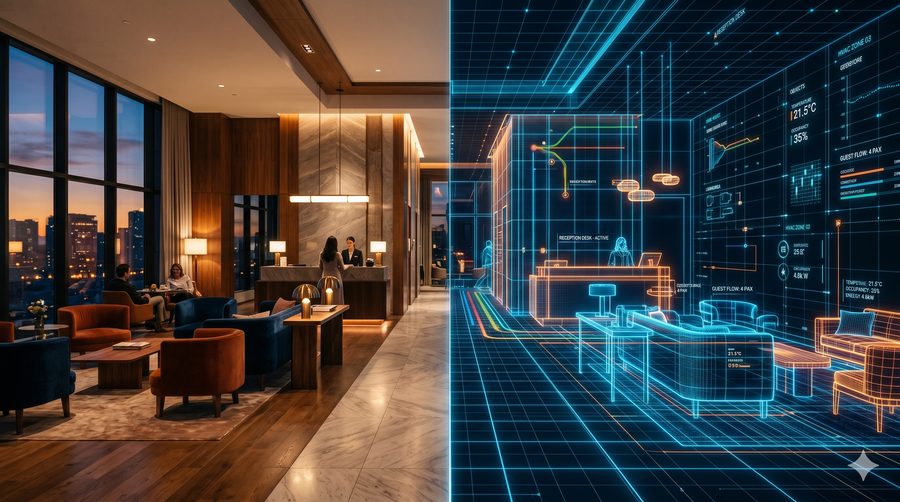
The first is a fast copy in Matterport. We scan the space with a Matterport Pro 3 and within days you have a link that opens in any browser, with no software to install. You walk the space, take measurements, show it to a colleague abroad. For maintenance, marketing and day-to-day operations, that is usually enough.
The second is the full Scan-to-BIM model at LOD 200 level of detail. Here the structure and the mechanical and electrical services are modelled element by element, so that a design team can work on them. This level is worth it when you are planning a refurbishment or extension — not because it is "better", but because the design work requires it.
What you actually receive
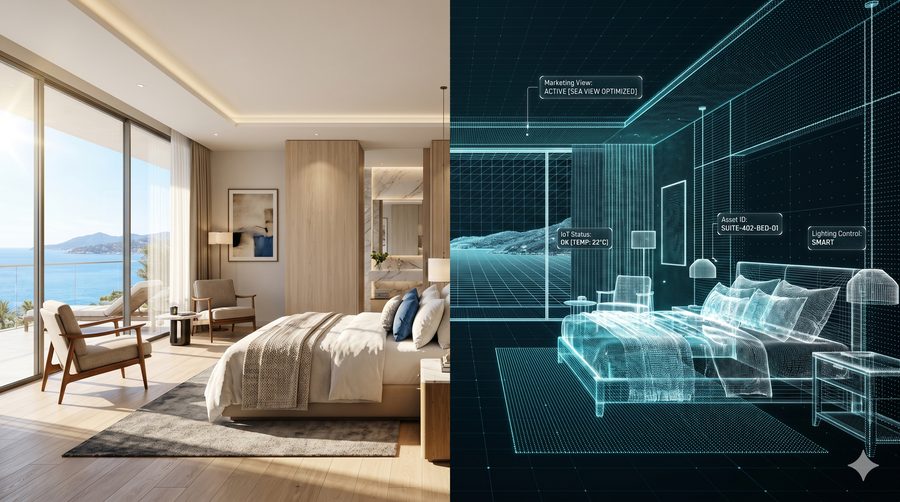
One point worth settling early, because quotations often leave it vague: exactly what is delivered, and in what format. The deliverables of a digital twin are:
- A Scan-to-BIM model at LOD 200 level of detail
- An IFC4 export — an open standard that opens in any BIM software, so you are not tied to one supplier
- An Autodesk Revit (.RVT) export for further editing by your design team
- Floor and ceiling plans in DWG
- The point cloud in RCS, as the record of the survey itself
The point cloud deserves particular attention. It is the primary measurement — what the scanner recorded, before any interpretation. If a disagreement arises later about what was where, the cloud is the answer.

Where it earns its keep in a hotel
The same survey serves four different departments, and that is where its economics lie:
- Technical department and maintenance — plant rooms, services, an equipment register with the technical specifications of each machine
- Marketing and sales — virtual tours for premium rooms, conference spaces and B2B presentations
- Renovation and design — real data for architects and engineers, instead of decades-old drawings
- Housekeeping and operations — a visual guide for setting up rooms and public areas correctly
What to ask before you commission it
Cost depends on the building's area and complexity, and on which file formats you choose — each export is quoted separately. A quotation that does not spell out which files are included cannot be compared with another.
Ask too whether the model can be updated periodically after works or extensions. A digital twin that is never updated becomes, after two refurbishments, just another out-of-date drawing.
In the next part of the series we go behind the scenes: how the digital copy becomes a daily tool for the technical department, and exactly where it saves time and money on maintenance.