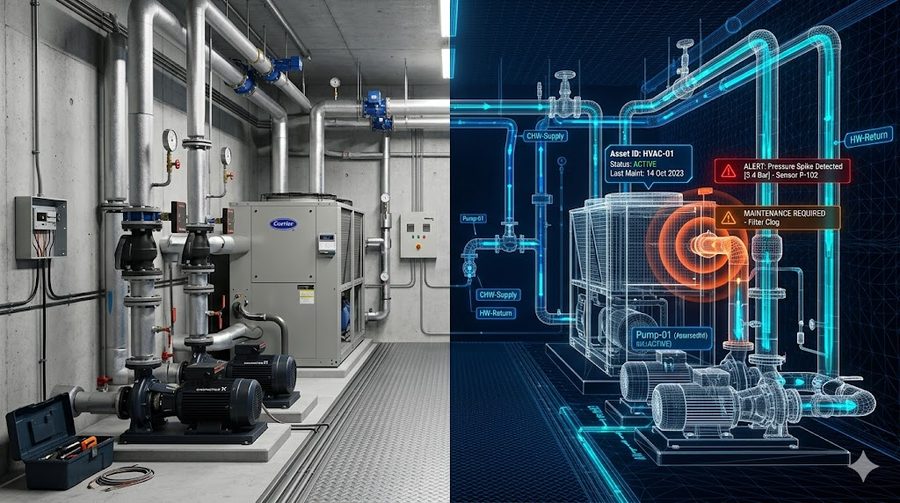
In every hotel there is one person who knows where everything runs. Which valve isolates which circuit, which drywall panel hides the third-floor drainage, which cable feeds the kitchen. None of this is written down anywhere — and when that person changes job or retires, it leaves with them. A digital twin is, above all, the way that knowledge stays with the hotel.
The real problem isn't the fault
In high season, every minute of downtime in a room or plant room costs twice over: in money and in guest reviews. But if you track where the time in a repair actually goes, the repair itself is usually the smallest part.
The time is lost beforehand: locating the problem, working out which drawing is current, opening a ceiling to confirm what runs above it, bringing a contractor to site purely so they can see what is there. A digital twin intervenes in precisely that interval.
Remote diagnosis
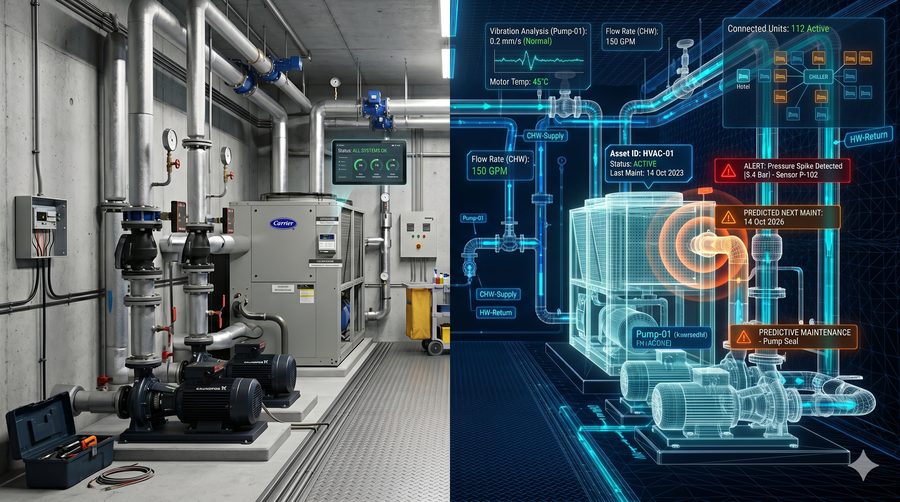
The technical manager — or the maintenance contractor, or the equipment supplier — opens a link and is standing in the plant room. They see the exact geometry of the space, measure whether the replacement part will fit, check where the new pipe run can go.
This has an immediate practical effect in groups with several properties, or where the technical department is not based on site. The question "can you send me a photo?" — which always produces the wrong photo, from the wrong angle — simply stops.
Training staff before the season opens
Hospitality is strongly seasonal and, with that, has high staff turnover. Every spring brings new maintenance staff who have to learn the building from scratch, at exactly the moment when pressure is highest.
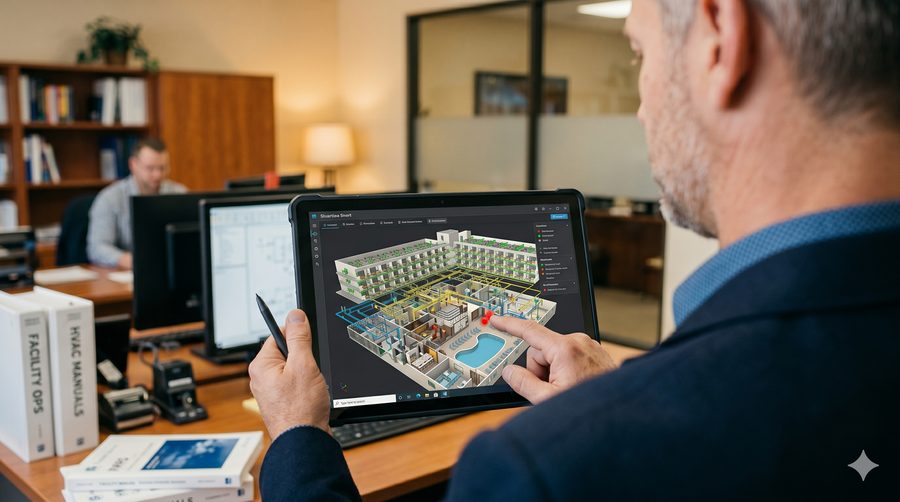
With a navigable copy of the building, that familiarisation can happen before they arrive. The new technician walks the plant rooms, finds the distribution boards, understands the floor layouts — without tying up a supervisor for tours during peak season.

Whatever is hidden behind the wall
This is perhaps the greatest value, and the one that is lost if it isn't planned in time. Services — plumbing, electrical, HVAC — are visible only in a short window: after they are installed and before they disappear behind drywall or concrete.
A scan at exactly that moment creates a permanent record of what sits behind every wall and above every suspended ceiling. The next intervention, in five or fifteen years, starts from certainty rather than exploratory openings.
If you are already in a construction or refurbishment phase, this is the one decision that cannot be taken retrospectively.
An equipment register
Beyond geometry, the survey can include an equipment register with technical specifications. Every pump, air handling unit and distribution board gets a position in space and carries its details with it.
In practice, when something fails, the identity of the machine is already there — nobody has to go down to the basement with a torch to read the nameplate.
Having seen the value for infrastructure, the next part moves to the other side of the hotel: how the same survey becomes a sales tool and brings in bookings.