We reach the last part of the series, and the one nobody expects: daily operations. A hotel's presentation standards — where the cushion goes, how the tray is set, how far apart the sunbeds sit — are usually described in text or in a handful of photographs. Both leave room for interpretation, and that room multiplies as the team grows.
The master room, in three dimensions
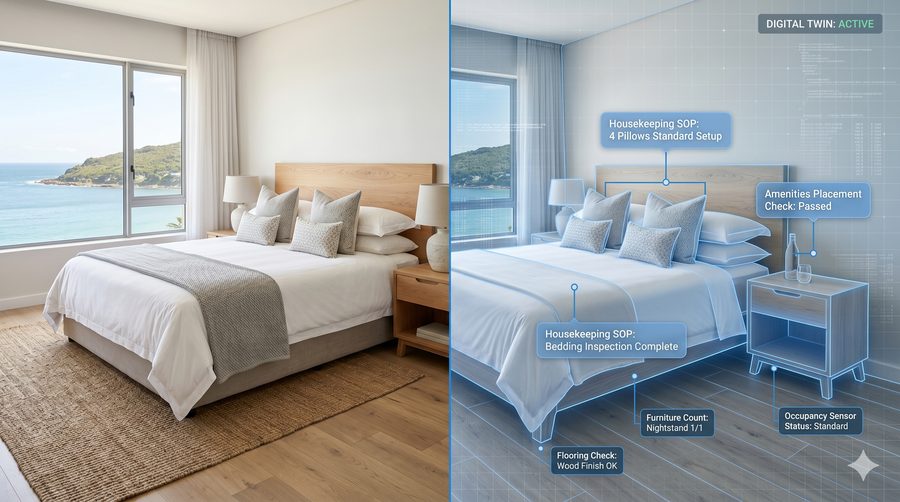
Instead of a booklet of photographs, floor staff have access to the three-dimensional model of a room dressed exactly as it should be. They can walk it, see every corner, measure if they need to.
The difference is that a walkthrough leaves no hidden corners. A photograph shows one side of the bed; the walkthrough shows the other side too, and the bathroom, and what a guest sees from the door as they walk in.
In practice this matters most for new staff and for groups with several properties, where consistency between hotels is hard to enforce through written instructions alone.
Instructions placed in the space itself
A tour accepts points of interest: markers placed in the space that open text, a photograph or a file. That allows an instruction to be hung exactly where it is carried out.
A marker on the minibar with the replenishment list. One on the air conditioning control with the setting the room is handed over at. One in the back-of-house area with the relevant procedure document.
The instruction stops being something to remember and becomes something you find in place.
Opening the season in public areas
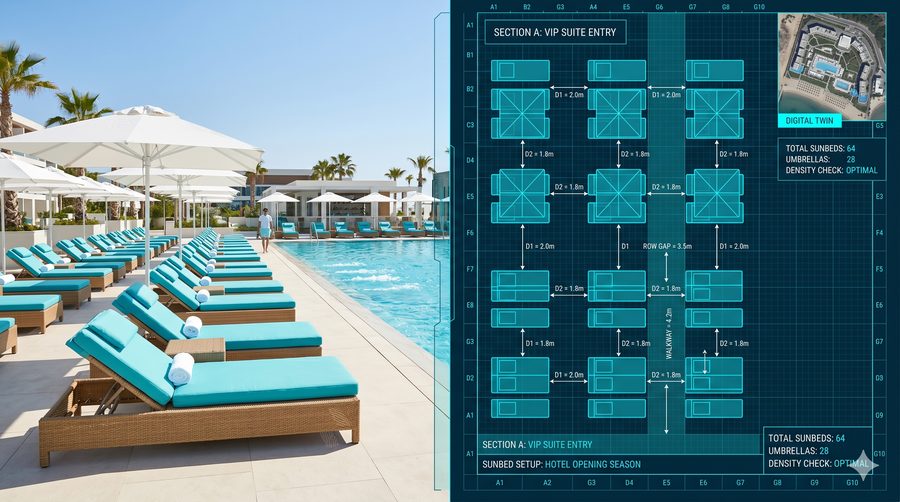
Every spring the same task repeats: exactly where the sunbeds go, how the lobby seating is arranged, what the bar layout is. That knowledge usually sits in the memory of two or three people.
With a captured, approved setup, the operations team restores the layout from a reference rather than from recollection. And when the people change, the setup does not change with them.
When something changes
Standards are not static. The amenities supplier changes, the furniture changes after a refurbishment, the brand standard changes after joining a chain.
The model is updated periodically after such works. That is also the condition for it staying useful: a master room showing last year's furniture is not a guide, it is a source of confusion.
Five parts, one file
In closing the series, the common thread is worth naming. The technical department, marketing, the refurbishment design team and the housekeeping team all use the same file — for entirely different reasons.
That is why a digital twin is not assessed as one department's expense. It is assessed as infrastructure, like the building's drawings: something that costs once and is used by everyone, for as long as the building stands.
If you would like to see how this applies to your own hotel, tell us what property you run and what is pressing hardest — and we will suggest where it is worth starting.